
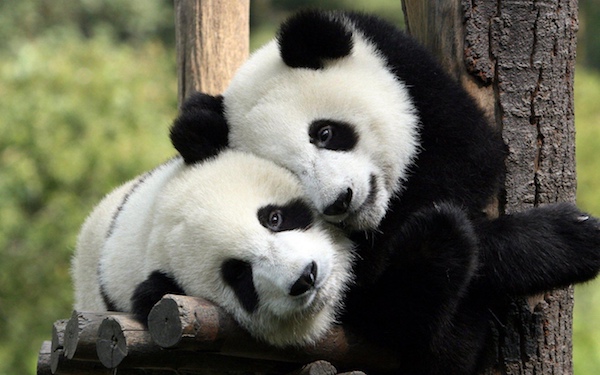
PANDA
The giant panda is also known as the panda bear or simply the panda, is a bear native to south central China.It is characterised by large, black patches around its eyes, over the ears, and across its round body. The name "giant panda" is sometimes used to distinguish it from the red panda, a neighboring musteloid. Though it belongs to the order Carnivora, the giant panda is a folivore, with bamboo shoots and leaves making up more than 99% of its diet.Giant pandas in the wild will occasionally eat other grasses, wild tubers, or even meat in the form of birds, rodents, or carrion. In captivity, they may receive honey, eggs, fish, yams, shrub leaves, oranges, or bananas along with specially prepared food
The giant panda has luxuriant black-and-white fur. Adults measure around 1.2 to 1.9 metres (3 feet 11 inches to 6 feet 3 inches) long, including a tail of about 10–15 cm (4–6 in), and 60 to 90 cm (24 to 35 in) tall at the shoulder.Males can weigh up to 160 kg (350 lb).Females (generally 10–20% smaller than males)can weigh as little as 70 kg (150 lb), but can also weigh up to 125 kg (276 lb).The average weight for adults is 100 to 115 kg (220 to 254 lb).The giant panda has a body shape typical of bears. It has black fur on its ears, eye patches, muzzle, legs, arms and shoulders. The rest of the animal's coat is white. Although scientists do not know why these unusual bears are black and white, speculation suggests that the bold colouring provides effective camouflage in their shade-dappled snowy and rocky habitat.The giant panda's thick, wooly coat keeps it warm in the cool forests of its habitat
Despite its taxonomic classification as a carnivoran, the giant panda's diet is primarily herbivorous, consisting almost exclusively of bamboo.However, the giant panda still has the digestive system of a carnivore, as well as carnivore-specific genes,and thus derives little energy and little protein from consumption of bamboo. Its ability to digest cellulose is ascribed to the microbes in its gut.Pandas are born with sterile intestines and require bacteria obtained from their mother's feces to digest vegetation. The giant panda is a highly specialised animal with unique adaptations, and has lived in bamboo forests for millions of years
WHERE WILL YOU FIND THEM
You will find the Panda at pen P18, In the Panda Canyon.