
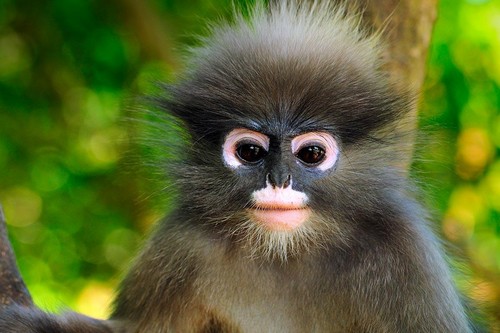
MONKEY
Monkeys live all over the world and come in various shapes, sizes and colors. As one of our closest relatives, these mammals are very intelligent and have opposable thumbs, allowing them to use tools and play games.There are more than 260 different types of monkeys. They are separated into two major categories: New World and Old World. The New World monkeys live in the Americas, while Old World monkeys live in Asia and Africa. One difference between the two categories is that Old World monkeys don't have prehensile tails; New World monkeys do. Old World monkeys have special pouches in their cheek where they can store food. Old World monkeys have rump pads, but New World monkeys do not. Also, Old World monkeys' nostrils are small and curved and set close together; most New World monkeys have round nostrils set far apart.
Monkeys are as varied in shape and size as humans. The world's smallest monkey is the pygmy marmoset, according to the University of Wisconsin. It weights only around 4 ounces (113 grams) and is only around 5 inches (12.7 centimeters) tall. The world's largest monkey is the mandrill. It weights around 77 pounds (35 kilograms) and is around 3 feet (1 meter) tall.
Many people think that monkeys just eat bananas, but that isn't true. Monkeys are omnivores. This means that they eat meat and plant-based foods. Most monkeys eat nuts, fruits, seeds and flowers. Some monkeys also eat meat in the form of bird's eggs, small lizards, insects and spiders.Most monkeys live in trees, but there are some that live in savannas or mountain areas. Monkey tribes stay on the move to find food, so one location isn't home for very long.Monkeys are very social creatures. Groups of monkeys are called missions, tribes, troops or cartloads. A troop will work together to take care of the young monkeys in the group. They also like to play, cuddle and protect each other.
WHERE WILL YOU FIND THEM
You will find the Monkey at pen M17, on the Monkey Trial.