
LION
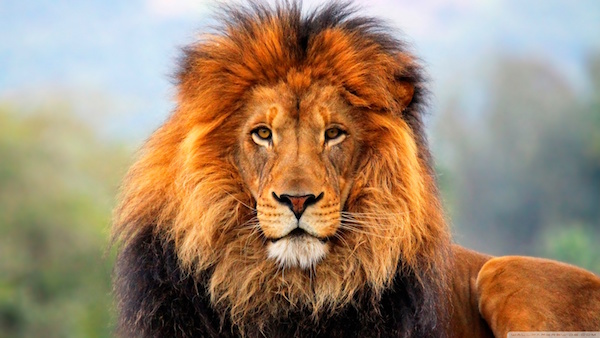
The lion is a species in the family Felidae and a member of the genus Panthera. It has a muscular, deep-chested body, short, rounded head, round ears, and a hairy tuft at the end of its tail. It is sexually dimorphic; adult male lions have a prominent mane. With a typical head-to-body length of 184–208 cm (72–82 in) they are larger than females at 160–184 cm (63–72 in). It is a social species, forming groups called prides. A lion pride consists of a few adult males, related females and cubs. Groups of female lions usually hunt together, preying mostly on large ungulates. The lion is an apex and keystone predator; although some lions scavenge when opportunities occur and have been known to hunt humans, the species typically does not.
Typically, the lion inhabits grasslands and savannas, but is absent in dense forests. It is usually more diurnal than other big cats, but when persecuted it adapts to being active at night and at twilight. In the Pleistocene, the lion ranged throughout Eurasia, Africa and North America, but today it has been reduced to fragmented populations in sub-Saharan Africa and one critically endangered population in western India.Lion populations are untenable outside designated protected areas.
African lions live in scattered populations across Sub-Saharan Africa. The lion prefers grassy plains and savannahs, scrub bordering rivers and open woodlands with bushes. It is absent from rainforest and rarely enters closed forest. On Mount Elgon, the lion has been recorded up to an elevation of 3,600 m (11,800 ft) and close to the snow line on Mount Kenya.Lions occur in savannah grasslands with scattered acacia trees, which serve as shade.The Asiatic lion now survives only in and around Gir National Park in Gujarat, western India. Its habitat is a mixture of dry savannah forest and very dry, deciduous scrub forest.
WHERE WILL YOU FIND THEM
You will find the Lion at pen L15, In the Northern Frontier.